Every bonsai collector has lost a tree they shouldn't have. Maybe it was a missed watering during a summer vacation. Maybe a repotting that happened a year too late. Maybe a fertilizing schedule that existed only in your head — until it didn't.
The difference between a thriving collection and one that's slowly declining usually isn't skill. It's consistency.
The Three Pillars of Bonsai Care
Every species has its quirks, but all bonsai care comes down to three fundamentals: water, nutrients, and roots. Get these right and your trees will forgive almost everything else.
Watering — The Most Common Killer
Overwatering and underwatering kill more bonsai than every disease and pest combined. The challenge is that there's no universal schedule. A Juniper in full sun during July needs water twice a day. The same tree in a shaded spot during October might need it twice a week.
The rules that actually work:
- Check the soil daily. Stick your finger half an inch in. If it's dry, water. If it's damp, wait.
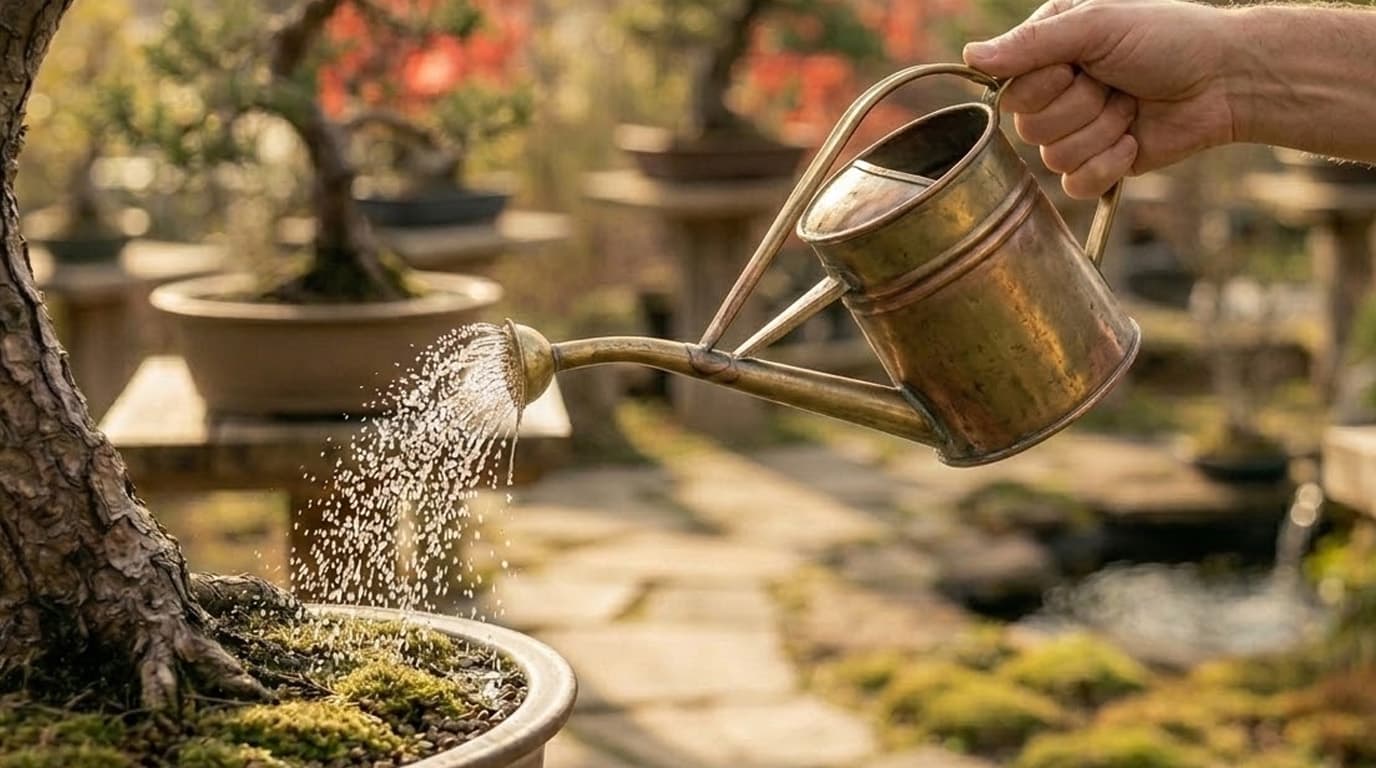
- Water thoroughly. When you water, soak the entire root ball until water runs freely from the drainage holes. Surface watering is worse than no watering — it encourages shallow roots.
- Adjust for the season. Your summer routine and winter routine should look completely different.
- Know your species. Tropicals like consistent moisture. Junipers prefer to dry out slightly between waterings. Black Pines want even less.
The biggest mistake beginners make is watering on a calendar instead of checking the soil. Your tree doesn't know what day it is.
Fertilizing — Feeding the Long Game
Bonsai live in tiny pots with limited soil. Unlike trees in the ground, they can't send roots deeper to find nutrients. You are their entire food supply.
A basic fertilizing schedule:
- Spring (active growth): Every two weeks with a balanced fertilizer (10-10-10 or similar). This is when your tree is building the year's structure.
- Summer: Continue every two weeks, but consider switching to a lower-nitrogen formula to harden off new growth.
- Fall: Switch to a low-nitrogen, high-potassium fertilizer (0-10-10). This strengthens the tree for winter and encourages root development.
- Winter: Stop fertilizing deciduous trees entirely. Evergreens can get a light feeding once a month if they're in a mild climate.
The key insight most people miss: fertilizing is about maintaining steady nutrition over years, not giving big doses. A tree that gets consistent, moderate feeding will always outperform one that gets sporadic heavy doses.
Repotting — The Task Everyone Puts Off
Repotting is the most intimidating care task for newer collectors, which is why it gets postponed. But a root-bound tree is a tree on borrowed time. Compacted roots can't absorb water or nutrients efficiently, and the decline is gradual enough that you don't notice until it's serious.
General repotting guidelines:
- Young trees (under 10 years): Every 1–2 years
- Mature trees (10–25 years): Every 2–3 years
- Old trees (25+ years): Every 3–5 years, sometimes longer
- Best timing: Early spring, just as buds begin to swell. The tree is waking up and has maximum energy to recover.
When you repot, you're not just changing soil — you're pruning roots, inspecting for rot, and giving the tree fresh growing medium. It's a health check and a reset combined.
Why Tracking Matters
Here's the uncomfortable truth: you will forget. Not today, not this month, but over time. Was it March or April when you last repotted that Maple? Did you fertilize the Junipers last week or the week before? When did you first notice that yellowing on the Black Pine?
Your memory is not a reliable care system. Especially as your collection grows past five or six trees, the mental load becomes impossible.
Tracking your care — whether in an app, a notebook, or a spreadsheet — does three things:
- Prevents missed tasks. A log shows you exactly what's due and what's overdue.
- Reveals patterns. When you can look back at a year of care data, you start seeing what works. Maybe your Maples always stress in August. Maybe your Junipers do best when you space out waterings more than you thought.
- Helps others help you. If someone else needs to care for your trees — whether temporarily or permanently — a care history is invaluable.
Building Your Routine
Start simple. Pick the three most important trees in your collection and commit to logging every care event for one month. Just the date, the action (watered, fertilized, pruned), and any notes.
After a month, you'll have two things: a habit, and data. Both are more valuable than you think.
Bonsai Legacy lets you log care events, set recurring reminders, and view your entire care history on a visual timeline. Start tracking for free →